
The quick answer
Unplug the air fryer and let it cool completely, then remove only the parts your model's manual says are washable. Follow that manual for dishwasher use, soaking time, and cleaners; basket coatings and appliance designs vary. Start with warm soapy water and a soft sponge, and avoid metal tools or abrasive pads on nonstick surfaces. Keep liquid out of the powered housing unless the maker's instructions specify a safe cleaning method.
What you’ll need
- Dish soap
- Baking soda
- A soft sponge or non-abrasive scrub brush
- An old soft toothbrush for corners and mesh
- A plastic scraper or spatula (not metal)
- Microfiber or dry towels
- White vinegar, optional, for mineral film on the tray
What's building up in that basket
Every cook cycle renders a little fat out of whatever's in the basket, and that fat settles into the mesh and corners along with tiny browned food particles. Left alone, the next cycle's heat bakes that layer on a little harder. It's the same way grease on a roasting pan turns darker and harder to lift with every use.
That's why a quick rinse stops working after a few uses even though it was enough at first. You're not just washing off fat anymore. You're trying to lift a layer that's partly been cooked onto the coating itself. Catching it with a proper soak before it bakes on again is far less work than scraping at a basket that's gone weeks without a real clean.
Keep water away from the main unit
An air fryer's heating element and fan live in the top of the main housing, and that part is never meant to touch water. Unplug the unit and let it cool fully before you start. Then take out only the parts designed to be removed: typically the basket, the tray it sits in, and a crumb catcher on some models.
Keep water away from the powered housing and heating area unless the appliance manual gives a specific procedure. Some manufacturers permit a carefully controlled damp-sponge cleaning of the element after unplugging and cooling; others provide different instructions. Follow the exact model's guide, use only the stated tool, and never pour or spray cleaner into the unit. If you cannot find the manual or the element is coated with stubborn grease, contact the maker rather than improvising.
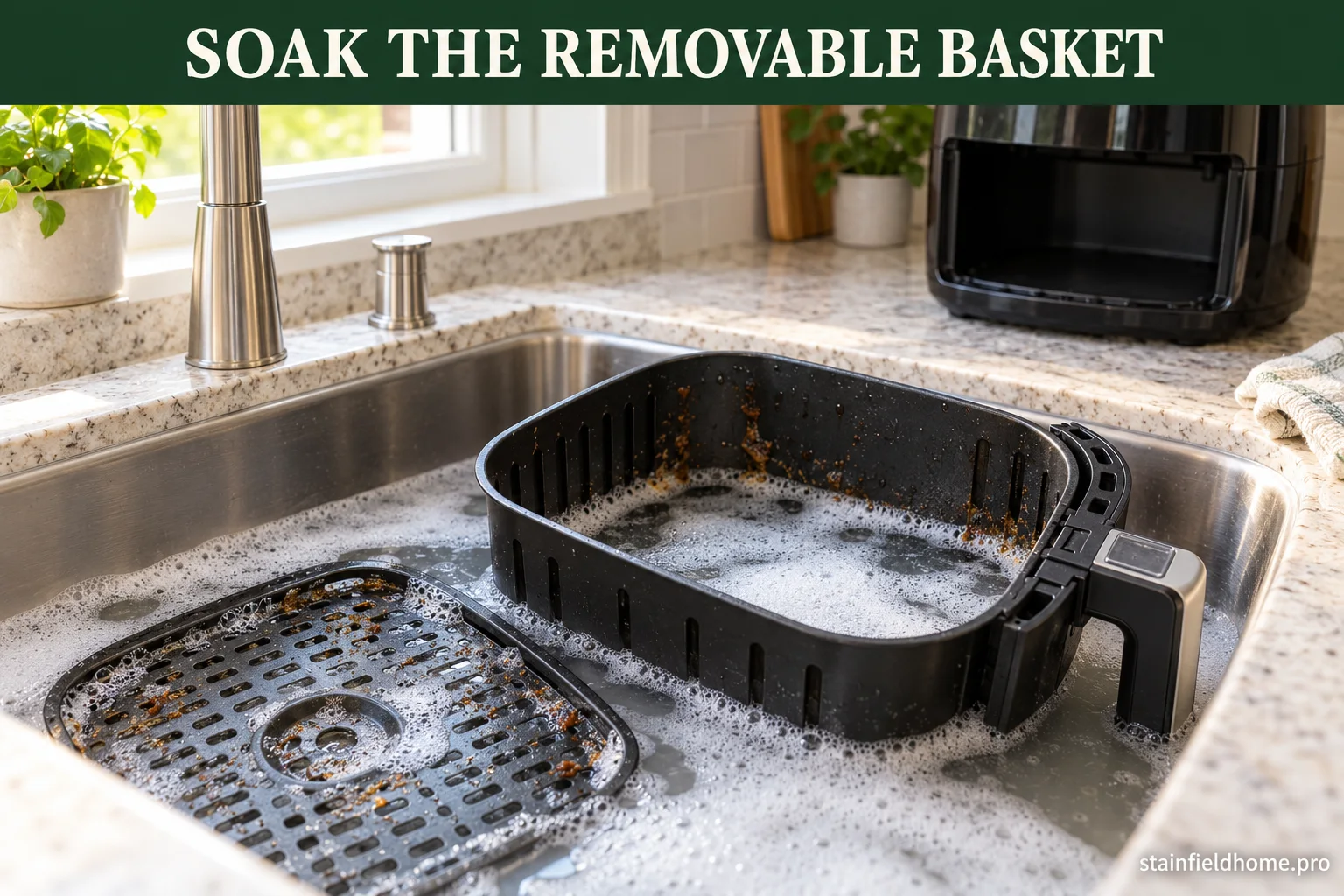
Soaking loosens most of it
- 01
Fill the sink or a basin with warm water and a squeeze of dish soap.
- 02
Submerge the removable basket, tray, and crumb catcher fully and let them soak for 15 to 20 minutes.
- 03
Use only the soak time recommended by the appliance maker. For example, Philips advises a five-to-ten-minute soak for stuck food on compatible removable parts; a longer soak is not automatically safe for every basket or coating.
- 04
After soaking, wipe with a soft sponge, using the mesh openings and corners as your guide for where grease tends to hide.
- 05
Rinse thoroughly and check under good light for any dull, dark patches that are still there before moving to the next step.
Baking soda paste for the stubborn, dark patches
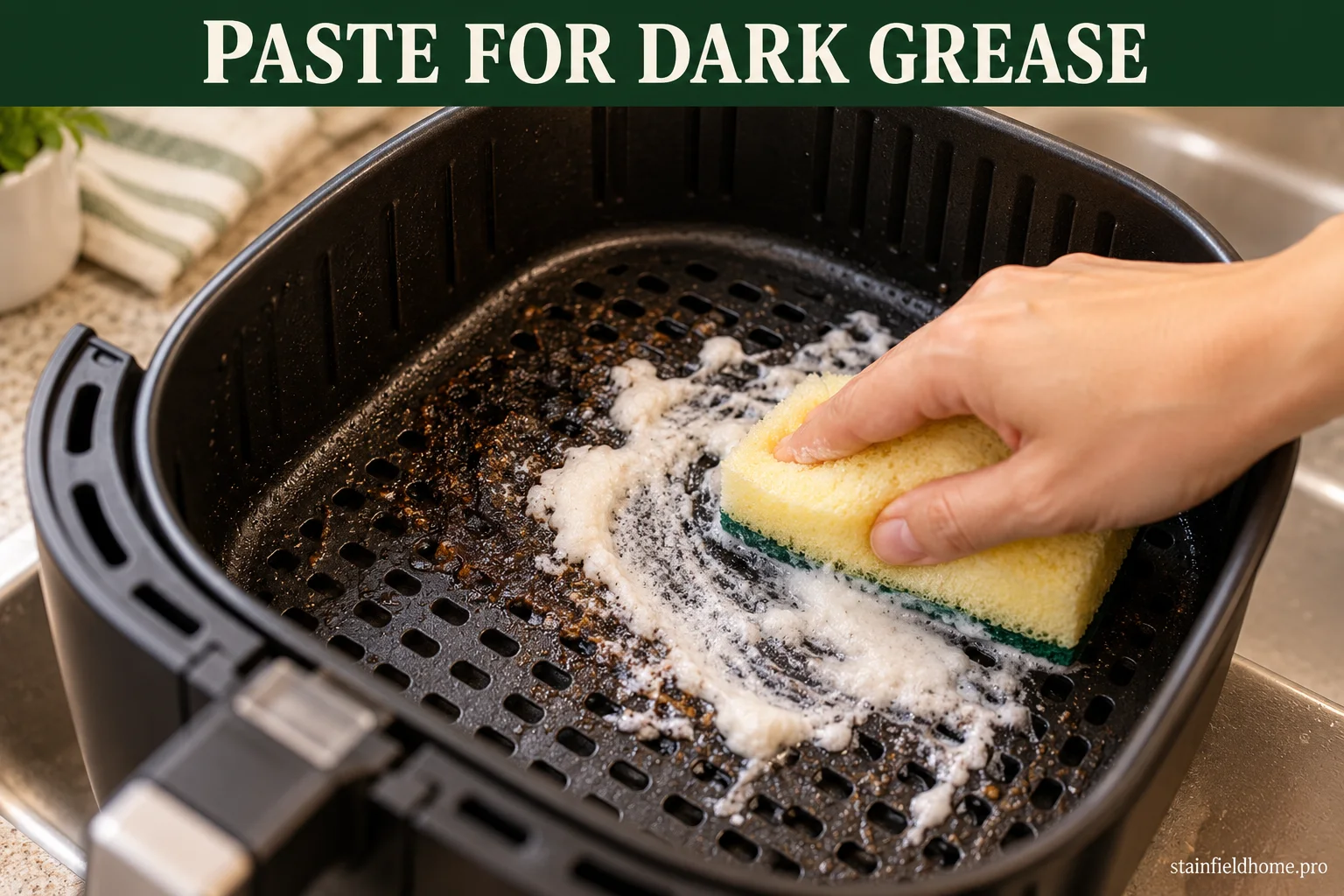
- 01
Check the manual before using baking soda, scouring agents, or a degreaser; manufacturers do not all approve the same products for nonstick coatings.
- 02
If the manual allows a paste or degreaser, use the least aggressive labeled option and apply it with a soft sponge for only the stated time.
- 03
Wipe along the mesh with light pressure. Do not dig into the perforations with a toothpick, knife, or hard-bristled brush, which can scrape the coating or bend the mesh.
- 04
Rinse and dry as the manufacturer directs, then inspect the basket under good light. Stop if the coating is scratched, blistered, or peeling; do not keep scrubbing a damaged surface.
- 05
If residue remains after one gentle pass, repeat only when the product and appliance instructions permit it. A manufacturer-approved liquid degreaser can be safer than abrasive force on some models.
The steam-loosen trick, and when to skip it
Some owners loosen heavy grease with steam. They put a shallow layer of water in the basket or the tray beneath it, then run a short empty cycle at a low temperature so the steam softens the residue before scrubbing. Manufacturers differ on this, and many say never to add water to a unit while it is running. Only consider it if your manual explicitly allows it, and never where water could reach the heating coil or fan housing.
A manual-approved soak and soft sponge are the general starting point; there is no single paste or soak time that is safe for every coating.
Protecting the nonstick coating
The coating is a functional surface, so preserving it matters more than making every dark mark disappear. A stain or discoloration that remains after the approved wash may be baked-on residue or a change in the surface; aggressive scrubbing cannot reliably distinguish the two and can make real coating wear worse.
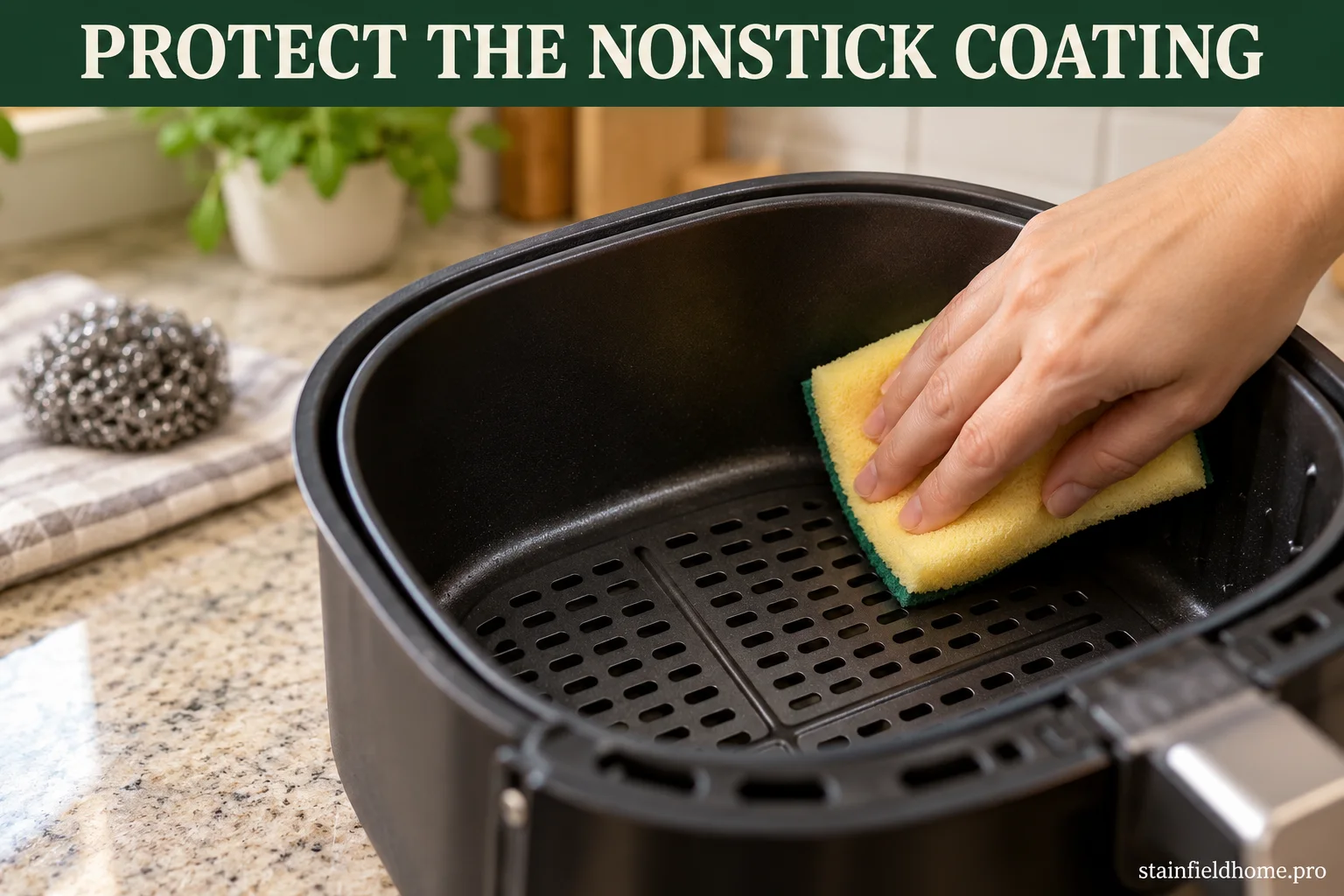
Use wooden or silicone utensils while cooking and a soft sponge for cleanup. Keep steel wool, metal spatulas, abrasive powders, oven cleaner, and unapproved degreasers away from the basket. If the manual lists a particular detergent or dishwasher setting, use that guidance rather than assuming every dishwasher cycle is equivalent.
Inspect the basket periodically. If the nonstick layer is flaking, peeling, or exposing the metal underneath, stop using the part and contact the manufacturer about replacement. Do not try to sand, season, or coat a damaged basket at home.
- Avoid steel wool, metal scouring pads, and utensils scraping against the basket; they can scratch or wear a nonstick surface.
- No oven-cleaner spray or bleach on the basket; both are harsher than the coating is designed to handle.
- Check your manual before the dishwasher. Some baskets are dishwasher-safe and some aren't, and high heat plus detergent can dull a coating that isn't rated for it.
- Dry every part fully, including the mesh underside, before reassembling: trapped moisture on an unfinished metal insert can lead to rust spots over time.
A quick wipe-down after every use prevents the worst of it
After cooking, unplug or switch off the appliance and let it cool for the time stated in the manual. Remove crumbs only when the parts are safe to handle. Rushing while it is hot risks burns and can deform a plastic-handled tool.
Wash removable parts with the approved method soon after use, especially after fatty foods or marinades. Dry the parts fully before sliding them back into the housing so trapped moisture does not linger around the appliance.
If smoke or an unusual odor appears during cooking, stop the cycle, unplug the unit when safe, and let it cool before checking for residue. Do not pour water into a hot basket or operating unit. If the smell persists after a correct cleaning, contact the manufacturer.
- Once the basket is cool enough to handle, remove loose grease and crumbs with a paper towel; do not handle a hot basket.
- Empty and rinse the crumb tray every use if your model has one; leftover crumbs burn and add to the buildup on the next cycle.
- Let every part air-dry fully before the next use so you aren't trapping moisture under a lid or in a stacked basket.
- Plan on a full soak-and-scrub deep clean weekly with regular use, rather than waiting until the basket looks visibly dark.
How often the basket needs a full soak
Wipe the basket after each use, then do the full soak-and-scrub about once a week if you cook bacon, wings, or breaded foods often. If you mostly cook vegetables, every two or three weeks is plenty. Two signs say you've waited too long: a tacky film on the basket, or a thin haze of smoke and a sharp smell when you start a cook. Both point to old grease, so clean before the next use. The longer grease keeps heating, the harder it is to lift.
Common questions
FAQ
Can I put the air fryer basket in the dishwasher?
Check your manual first: many removable baskets and trays are dishwasher-safe, but some nonstick coatings hold up better with hand-washing over time. If you're not sure, hand-washing with warm soapy water is the safer default.
Is it safe to run water into the bottom of the air fryer to steam-clean it?
Only if your exact model's manual explicitly describes a steam-clean function. Otherwise, do not add water to a running unit. Clean removable parts as directed and keep liquid out of the powered housing.
Why does my basket smell smoky even after washing?
Residual grease or food may remain in corners, but check the manual before extending a soak or using a paste. Clean removable parts with the approved method. If odor or smoke persists, stop using the appliance and contact its maker.
Will baking soda scratch the nonstick coating?
Do not assume baking soda is approved for every coating. Check your appliance manual; use only recommended cleaners and a soft sponge. Avoid abrasive powders or tools unless the manufacturer specifically permits them.
Sources reviewed
Keep reading
Related guides

Spills and body oils on Bouclé sofas and chairs
How to Clean a Bouclé Sofa or Chair Without Flattening the Texture
Spot-clean a bouclé sofa or chair by its cleaning code, protect the looped pile from matting, and know which spills need a dry solvent instead of water.

Permanent hair dye on Bathroom countertop
How to Remove Box Hair Dye From a Bathroom Countertop
Get permanent hair color off quartz, laminate, cultured marble, or sealed stone before it sets, using the mildest method the surface allows and never an abrasive pad.
Yellowed tape adhesive on Painted wall
How to Remove Yellowed Tape Residue From a Painted Wall
Take aged, hardened tape adhesive off painted drywall without pulling the paint, using warm heat, an oil to soften the gum, and the gentlest possible scrape.

Formula and spit-up on Baby car-seat harness straps
How to Clean Spit-Up From Car-Seat Harness Straps
Safely remove formula and spit-up from car-seat harness straps without soaking, bleaching, or weakening crash-safety webbing.