
The quick answer
Check the comforter's care label first. Spot-treat yellow body-oil marks gently, then wash the entire comforter only by the method the manufacturer allows, using enough machine capacity for free movement and a thorough rinse. The most important final step is complete low-heat drying until every down cluster is dry and lofted; trapped moisture can cause clumping, odor, and mildew.
What you’ll need
- care label
- mild down-safe detergent
- large-capacity washer if allowed
- white cloth
- dryer balls or clean tennis balls if manufacturer allows
- large-capacity dryer
- dry towels
Why down comforters yellow
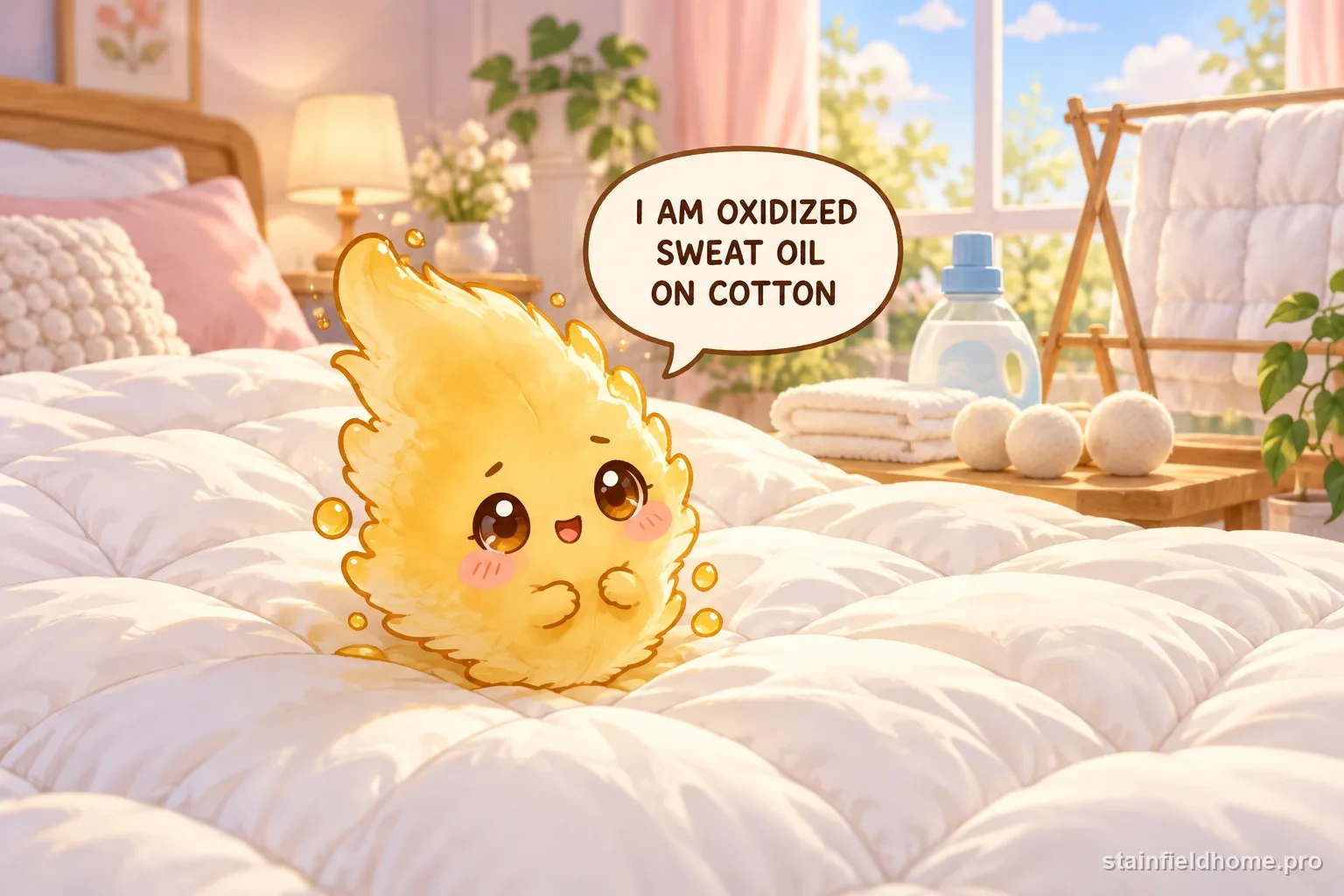
The yellow is body oil and sweat that has passed through the duvet cover over time, soaked into the cotton shell, and oxidized. It concentrates where your body touches the comforter most — the top third, around the chin and shoulders. Sometimes it is worse on one side from a person who runs hot or uses night creams and hair product.
Because the stain is oil that has aged and set, a quick wash rarely clears it. It needs a proper degreasing pretreat and then a full, careful wash — and the wash itself is the part that damages comforters if done wrong.
Pretreat the yellow areas
- 01
Lay the comforter flat and find all the yellowed zones in good light.
- 02
Work a small amount of a grease-cutting dish soap or a down-safe detergent directly into each mark with a fingertip or a soft white cloth.
- 03
Let it sit 20-30 minutes; keep it slightly damp so it does not dry.
- 04
Gently rub the shell fabric against itself to work the soap through — do not scrub hard enough to shift the down inside.
- 05
For white comforters, an oxygen-bleach paste on the worst spots before washing helps.
Washing without wrecking the loft
Use a front-loader or a large commercial machine — a top-loader with a center agitator can tear baffles and mat the down. Wash warm (or as the label says) on a gentle cycle with a small amount of mild or down-specific detergent; too much soap leaves residue that clumps the fill. Run an extra rinse.
Do not wash a comforter labeled dry-clean-only, and do not wash one with torn seams — wet down escaping into the machine is a mess and the comforter loses fill. The Down and Feather Company and most makers publish a specific wash method for their product; follow that over generic advice.

Drying is where comforters are saved or ruined
Wet down clumps into heavy wet balls, and if the inside of a cluster stays damp it mildews and smells. Dry the comforter on low heat for as long as its care label directs, checking the center and corners periodically; dryer balls can help separate clumps when the maker permits them. Pause the dryer to feel the baffles and gently break apart any lumps through the shell, redistributing the fill without pulling on seams.
It is dry only when there are no cool or heavy spots and the whole thing has returned to its usual loft. Do not put it back on the bed or store it damp. If the label prohibits tumble drying, or your dryer cannot turn the comforter freely, use a professional launderer familiar with down instead of substituting an improvised air-dry method.
If the yellow will not fully come out
Old, deeply oxidized oil staining on the shell may lighten but not disappear. Since it is on the outer cotton, not the down, and a duvet cover hides it, a faint residual tint is a livable result — do not run the comforter through multiple aggressive washes chasing it, because each wash costs some fill loft.
A comforter that has gone flat, smells musty even after proper drying, or leaks down through the shell has reached the end of its life regardless of the stain.

Check the care label before wetting down or shell
Down-filled comforters are not all washable. Some makers allow a large front-loader and low-heat drying; others recommend spot cleaning and professional laundering because washing can compromise a down-proof shell or void a warranty. Read the sewn-in label and the manufacturer's care page before applying a pretreatment. If the tag says spot clean or dry clean only, do not soak or machine wash the entire insert, even if another brand's comforter tolerates it.
Also check the shell material and any colored piping or embroidery. A white oxygen-bleach product may be appropriate for some washable cottons, but it is not a universal treatment for a down insert, and a paste can leave a concentrated ring. Test any permitted product on a hidden seam, follow its dilution directions, and stop if color transfers, the shell puckers, or the stain grows beyond the original area.
Keep a localized stain localized
- 01
Shake the fill away from the stain and support the shell on a clean white towel so liquid cannot press through to another panel.
- 02
Apply the smallest amount of label-approved mild cleaner to a white cloth, then blot the shell from the edge toward the center; avoid pouring cleaner into a baffle seam.
- 03
Lift detergent residue with a second cloth dampened with plain water, using a light press rather than rubbing the cotton shell.
- 04
Press with a dry towel to draw out moisture and let the spot dry completely before deciding whether a full wash is needed.
- 05
If the area is large, the fill itself smells, or the shell is fragile, stop spot treatment and ask a professional cleaner whether the item can be wet-cleaned safely.
Separate a removable duvet cover from the insert
If the yellow is on a removable cover rather than the down shell, take the cover off and treat it according to its own fiber and wash label. A washable cotton duvet cover can usually be pretreated and laundered more easily than the filled insert, while silk, linen blends, dark prints, and decorative trim may need a cooler or professional method. Do not assume that a stain on the cover means the down inside also needs washing.
For yellowing that has reached the comforter shell, the mark is often an accumulation of body oils and perspiration over months, not a single fresh spill. Several mild, label-approved passes may lift some color, but there is no safe promise that an old oxidized shadow will return to bright white. Avoid sunlight or chlorine as a shortcut unless the manufacturer explicitly permits it; uneven bleaching can discolor the shell and repeated whole-item cleaning can shorten the life of the fill.
Use a machine large enough for the wet comforter
A king-size comforter needs room to move both when dry and after it absorbs water. If it is packed tightly into a household drum, detergent and rinse water cannot circulate through the baffles and the machine may not extract enough water for a manageable dry. Use a large-capacity front-loader only when the product instructions allow home laundering; otherwise take it to a professional service equipped for bulky down bedding.
Do not force a wet comforter through a small opening or pull on a loaded corner to remove it. Wet down is heavy, and tugging can stress baffles and stitching. If you see a seam opening or fill escaping, stop the cycle and handle the item carefully; a repair before cleaning may prevent a larger loss of fill.
Keeping the next one clean
- Always use a duvet cover and wash it every 1-2 weeks — the cover is the sacrificial layer.
- Add a flat top sheet between you and the covered comforter to catch most of the oil and sweat.
- Let hair dry and night creams absorb before bed.
- Air the comforter over a rail for an hour every few weeks; dry down yellows and smells far less.
- Wash the comforter itself once or twice a year, no more — each wash shortens its life.
Common questions
FAQ
Can I wash a down comforter in a regular top-loading machine?
Only if it has no center agitator. An agitator can tear the internal baffles and mat the down permanently. Use a front-loader or a large commercial front-load machine, a gentle warm cycle, a small amount of mild detergent, and an extra rinse.
How long does it take to dry a down comforter?
Usually 2 to 4 hours on low heat with dryer balls, pausing every 30-45 minutes to pull it out and hand-break the clumps. It is done only when there are no cool or heavy spots anywhere and it has returned to full loft. Under-drying is what causes musty, clumped down.
The yellow stain did not fully come out. Should I wash it again?
Not repeatedly. Old oxidized oil on the cotton shell may not fully clear, and each wash costs some down loft. Since a duvet cover hides the shell, a faint residual tint is an acceptable trade. Replace the comforter only if it has gone flat, smells musty after proper drying, or leaks feathers.
Sources reviewed
Keep reading
Related guides
Yellow sweat and body oil on Memory foam pillow
How to Clean Yellow Sweat Stains on Memory Foam
Spot-clean yellow sweat and body-oil marks on memory foam without soaking, machine washing, or trapping damaging moisture inside the foam.

Spills and body oils on Bouclé sofas and chairs
How to Clean a Bouclé Sofa or Chair Without Flattening the Texture
Spot-clean a bouclé sofa or chair by its cleaning code, protect the looped pile from matting, and know which spills need a dry solvent instead of water.

Burnt-on grease and food residue on Air fryer basket
How to Clean Burnt-On Grease From an Air Fryer Basket
Break down baked-on grease in an air fryer basket with a soak and baking-soda paste, without scratching the nonstick coating or getting water near the heating element.

Permanent hair dye on Bathroom countertop
How to Remove Box Hair Dye From a Bathroom Countertop
Get permanent hair color off quartz, laminate, cultured marble, or sealed stone before it sets, using the mildest method the surface allows and never an abrasive pad.